Wednesday, June 20, 2018

IVY LEAGUE BOYS


A major difference between President Trump & his recent predecessors & competitors is that he isn't an "Ivy League boy" (for lack of a better term) as many of them were. Ivy Leaguers (regardless of where they might have gone to college) value things like nuance, sophistication, generalization, etc. in communication. They also don't seem to understand or appreciate how things work in the real world, international, playing-for-keeps geopolitical arena. Powerful autocratic leaders such as Kim Jong-un have no respect for people who try to negotiate with them from a position of what they see as weakness, indecision, or ambiguity.

In interviews following the meeting with Kim, President Trump brought something to light that really didn’t surprise me, nor should it have surprised anyone who has made a serious effort to understand him. He mentioned the need to use rhetoric to make his point with Kim. Interestingly, he said that he felt kind of foolish using some of the rhetoric in his remarks about the North Korean leader. But he also knew from decades of negotiating for many things with many kinds of persons with various kinds of personalities & motivations, that this kind of preliminary communication was necessary for the upcoming negotiation to be effective.

Think what you will about the President (which I’m sure you do; it’s pretty hard to be neutral). But if you will be honest with yourself, you have to admit that he is not an “Ivy League boy.” He knows how to compete & win (at least conditionally in the case of North Korea)  with the “Big League boys” in dealing with real world, immeasurably serious problems that need to be faced & overcome.

Saturday, June 16, 2018

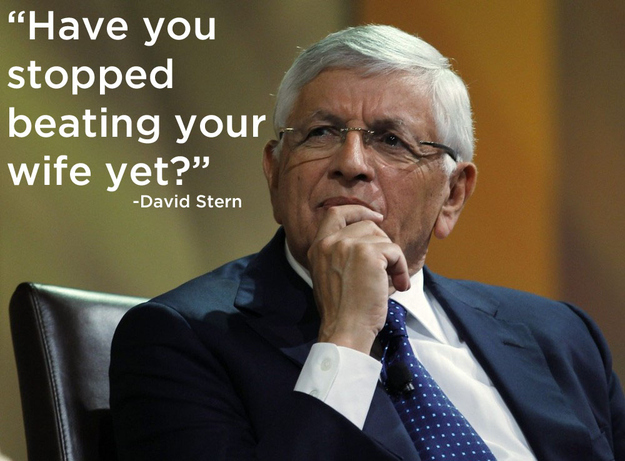
WHEN DID YOU STOP BEATING YOUR WIFE?


This is probably one of the original “gotcha” questions. That’s because the questioner assumes that other person is or was a wife beater. There’s no way to come out well without removing the assumption that is in the question.

The same kind of technique is being used in political “debate” today. An example this week was a “reporter” asking the President when he is going to stop breaking up immigrant families. I want to remove the assumption behind the question by making 2 observations.

First, in the milieu that has historically made up the secular Left, it’s hard to find anyone who is a vocal or practical advocate for the traditional family. So, the idea that maintaining the cohesion of traditionally-structured families (father/mother/children all fitting into their roles as a nuclear family) should be used as an argument. It seems a bit disingenuous.

Second, it may be possible that nuclear families are being broken up by something much more insidious that a nation seeking to maintain its borders & enforce its immigration laws. I don’t know the statistics, but it seems that most of those who cross illegally into the US, or who remain illegally, are already physically separated from their family members. 

We have seen the pictures of groups of children accompanied by a few adults. Where are these children’s parents? Either in their homeland, or already living illegally in the US.

My point is that their families are already separated. If we enforce our laws & make it less likely for people to enter or stay illegally, these families are actually more likely to remain together.

Sunday, March 11, 2018

WHERE DID WE GET OUR LAWS?


Historically, laws & adjudication of law in the US has been (at least ideally) based in what is called the Judaeo-Christian ethic. This means that the Old & New Testaments have provided the basis on which legislators & courts have functioned.

Some have argued that the Bible is not a good basis for law. Among other things, they have used passages like Exodus 22:18 (“You shall not allow a sorceress to live”) to show that the Bible shouldn’t be used.

I believe that such an idea is faulty. One reason is that there are at least 3 aspects of Old Testament law – civil, ceremonial, & moral. We have to think about these aspects & see how they relate to each other if we are serious about understanding how the Bible has influenced law in the US.

Briefly, civil law in the Old Testament was intended to be the legal code in ancient Israel. Ceremonial law prescribed how God was to be worshiped. Moral law described the ethical foundation that was the basis for everyday behavior. This moral law in many ways reflects how the New Testament teaches Christians to conduct themselves.

Exodus chapter 22 gives several examples of how we have based our legal system on the biblical model: the principle of appropriate restitution (vs 1); the right to defend personal property (vs 2); judicial discretion to determine what is best in a particular case (vs 7-8); the necessity of honest testimony (vs 10-13); equality of all before the law without regard to economic status (vs 21-22).

I’m thankful for the magnificent, firm foundation that has been left to us in Scripture. God has truly blessed us.  Let’s pray that righteousness will continue to be established in our land!

Sunday, March 4, 2018

SOME THOUGHTS ON PREACHING & MOTIVATIONAL SPEAKING


We get to hear a lot of preaching. That has gotten me to thinking about a couple of kinds of public speaking that we sometimes get confused in our thinking. Those 2 things are preaching & motivational speaking.

My conviction is that preaching involves proclaiming content of the Bible, thru the supernatural enablement of the Spirit, for several specific, redemptive purposes. These purposes are to bring people into a personal relationship with Christ, to inspire believers’ spiritual growth, & to encourage disciples to fulfill their specific God-given part in fulfilling the Great Commission.

Preaching is not the aim or climax of the worship service; like every other part of a service, it is intended to prepare people to respond to what the Holy Spirit desires to do in their lives.

In very broad terms, motivational speaking encourages people to develop their own abilities & talents so that their lives can reach maximum potential. Motivational speakers sometimes use biblical texts or stories to confirm or illustrate what they are saying. As a result of self-development, individuals should become better partners, parents, employees, leaders, etc.

There are some overlaps between these 2 kinds of speaking. Both should inform & motivate. Both should result in lives that are fuller & better lived.

But, there is a difference.

Preaching should begin & end with God’s sovereign plan for people. Motivational speaking tends to focus on our desires & plans. It may only make God & the Bible incidental in reaching the goals that we have set for ourselves.

Preaching focuses on the fulfillment of what God ultimately wants, while motivational speaking values what we desire at that particular season of our lives. I can be a successful spouse or employee without necessarily finding the place that God has ordained for me.

Just a few thoughts for consideration...

Thursday, February 22, 2018

OPINIONS


The other day we were reading about Jesus’ healing of the Roman centurion’s servant (Luke 7:2-10), & I saw something interesting. 3 opinions were expressed about the centurion. One was how others saw him, another was how he saw himself, & the last was how Jesus saw him.

Notice the contrast between how others saw him & how he saw himself. The Jews spoke well of him because he was a compassionate benefactor. So, to them he was worthy to make a request of Jesus. “He’s such a great guy. Surely Jesus will see him as worthy of help.” When Jesus arrived on the scene, He saw someone who didn’t view himself as a great, deserving man. The centurion said, “Lord, I don’t deserve to have You enter my home.”

Jesus didn’t seem to look at him from either category, worthiness or unworthiness. He saw the man’s faith & marveled at it. In fact, in a remark that must have stung the sensibilities of those who were standing by. “I say to you, not even in Israel have I found such great faith.”

The centurion didn’t put his faith in the estimation of others, nor in his own worthiness. He recognized the authority of Jesus. Jesus could simply speak a word & it was done. He saw his own authority as a Roman officer to command others as a reflection of a life-changing truth – Jesus has absolute authority to speak to all creation.

God isn’t impressed by what others think of us, or by what we think of ourselves. But if we can trust in Jesus’ authority to reign in our lives & in all the circumstances that surround us, we can expect to see Him work in powerful & miraculous ways to bring about His plan in our lives & in those we love.

Thursday, February 15, 2018

GOD REALLY DOES SPEAK TO JOY BEHAR


Just like there is no end to the making of books, there is no end to the making of snarky remarks. I want to respond to what Joy Behar’s remark about VP Pence. I don’t intend to insult her; I only want to take her reasoning to what appears to be her understanding of faith.

Essentially, she seems to mean that communication or relationship with God is a one-way conversation. We can talk to Him, but if we think that He will talk to us, there is something wrong with us. We live in the “real world,” & faith (whatever we have determined it to be) is a matter for the individual to work out in private. He had better keep it there, too.

Fair enough, in our secularized & individualized culture.

A one-way relationship or way of communicating with God (or, in popular parlance, “god”) is very convenient. It can imply at least a couple of things. First, we get to use God on our terms; He is, or is not, whatever we decide. He might hear us if we talk to Him, but He has nothing to say to us. Second, it can mean that, whatever we think He is, He has no relevance for the “real world” where we live every day.

My belief, & that of hundreds of millions of Christians around the world, is that God does in fact speak to people. He has done this in the past (His revelation to us in the Bible, & also throughout Christian history). He continues to speak to us today thru His Word & thru the faithful working of the Holy Spirit in our daily lives. Christians read the Bible, pray, attend worship services, & expect to hear from God in the daily experiences of life.

To take it a step further, God even speaks to those who are not necessarily listening. This happens as He works to reveal Himself to those who are not yet in a personal relationship with Him thru Christ.

The fact is, we all need to hear from Him. Otherwise, we are lost. Lost, just like those who believe that faith is a one-way communication, the parameters of which each individual can determine.

Monday, February 12, 2018

WHO’S THE REAL HERO?


We’ve been reading about Joseph (Genesis 37-47) this week in our devotions. There are all kinds of lessons that can be learned thru his experiences (godly character & integrity, leadership, faithfulness to a God-given vision, etc). You’ve probably heard a lot of preaching or teaching about these topics based on Joseph’s life.

I have a little problem with not seeing beyond these wonderful & helpful insights.

Sometimes, we don’t see the big picture because the snapshot that encourages or challenges us where we are right now seems so powerful to us. Notice what Joseph said to his brothers: “God sent me before you to preserve for you a remnant in the earth” (Genesis 45:7).

Joseph is really not the hero of the story of Joseph. He & his experiences are the snapshot. In the big picture, God is the hero. His redemptive plan in progress is what I’m encouraging you to see.

What was happening in Joseph’s life? God allowed him to be sent to Egypt to preserve the descendants of Abraham, who were ordained to be a blessing to the world (Genesis 12:1-3). Later, the Israelites underwent 400 years of slavery in Egypt before being delivered by Moses (whose life gives us another series of wonderful lessons). Joshua victoriously led them into the Promised Land, the Judges guided them during generations of national apostasy & restoration. David united the tribes. Solomon’s son Rehoboam split the kingdom & initiated a downward spiral that eventually ended in national destruction. After their restoration in the Promised Land under leaders like Ezra & Nehemiah, the Old Testament period came to an end.

A few hundred years later, the Gospels were written to give us the story of Jesus. As the son of Mary, He came as a Jew, a direct descendant of the people whom God had used Joseph to preserve.

You see, each part of the Old Testament is a necessary part of the process in which God brought the fulfillment of His plan to bring salvation thru Jesus. That’s the big picture.

Enjoy the stories, glean the lessons from them. But remember, those are just snapshots. Don’t forget the real Hero who is behind it all.

PERILOUS TIMES

It’s easy to get caught up in a couple of ideas that are not true. The first is that our situation of lawlessness & turmoil hasn't h...